









I want to ask you something, directly and gently: Are you dissociated?
I was.
It was a wise adaptation once, a way a child learns to survive a tough environment. The same skill that let me disappear into books and my own inner world, the skill that got me through, is the skill that dims my aliveness now, as an adult.
You may also Like


The thing that saved you as a kid can make your adult relationships harder, especially your marriage and especially with the people closest to you.
High-functioning dissociation, the kind that shows up and gets everything done, can look to the one who loves you like you don’t care.
What is happening is an old adaptation, one that kept you safe once, now running in a body that no longer needs it to.
That same adaptation often shapes sexuality too, and not always in the direction you’d expect: sometimes it shows up as shutting down or avoiding closeness, but sometimes it shows up as seeking intensity, risk, or hypersexuality as a way to feel something, or to feel in control. Either way, it’s the same old wiring, not necessarily a reflection of what you may want now. We have to notice that and make the effort to connect and stay emotionally current anyway.
Here is the part I want you to hold onto before we go further: the same nervous system that learned to disappear is also hardwired to come back online. It did not forget how; rather, it has been waiting for enough safety to try.
Your physiology, integration, and aliveness do not have an expiration date.


Mine started waking back up well past 40, and I do not think that timing was random. It was right in the heart of perimenopause, when we are hard wired to awaken.
There is a part of this I have not told you yet here on Substack: what functional dissociation does to desire, to arousal, and to the body in bed with someone you love.
It surprised me more than anything else, and I am eager to dive in and explore it together.
I. The Pier
I was seven years old on my grandparents’ pier on the Chesapeake Bay.
My older male cousins had caught Maryland blue crabs, something we did a lot every summer, but usually we measured them first for maturity and kept them in a crab pot until we roasted them on Sunday.
My two cousins were catching baby crabs, putting them in gasoline, and blowing them up.
I watched it happen and told them to stop. Something in me knew, with the clarity that children have before they learn to doubt themselves, that this was wrong.
I went to find my mother.
She was on the deck with the adults, drinking wine after dinner in the evening light.
I tried to tell her what was happening, but she cut me off.
I tried again. She told me I was being too sensitive, that I always exaggerate, and that I needed to make it work.
I remember the specific quality of that moment: the way my knowing had nowhere to go.
Later, she told me never to interrupt her at dinner parties.
Later still, when something more serious happened with those same cousins, and I brought it to her, she seemed to freeze. She denied it, told me it never happened. What followed was the silence I came to know well: icy, encompassing, her bedroom door closed, and her absence filling the house.
Then a few hours later, she would emerge, reset, as if nothing had been said, as if I had not spoken and the case was closed.
I was never compliant enough. I could not sustain the performance she needed. Every difference of opinion became a rupture we never repaired. I cannot recall a single successful repair between us, not one, among hundreds, maybe thousands, of ruptures. Now it’s too late, she is in memory care with Alzheimer’s disease.
What I know now, that I could not have known then, is that she may have carried her own version of this experience, her own unwitnessed history. I do not know and I will never know. What I do know is that I love her, I have forgiven her, and I am no longer waiting for her to tell me what I felt was real.
My body already knows.
II. Who She Was
I am not diagnosing my mother or blaming her, I am describing a pattern I experienced and that I have since seen in the bodies and histories of hundreds of women who come to me as patients.
Narcissistic traits are common and she had many of them.
Narcissistic personality disorder is a clinical diagnosis characterized by a pervasive pattern of grandiosity, need for admiration, and lack of empathy. [1] Before it is a diagnosis, it is an ecosystem. A child growing up inside it learns its rules early and completely. Here is what that ecosystem looked like from where I stood:
• My needs registered as inconvenient
• She required constant admiration and validation, including from me
• My autonomy was often met with punishment or withdrawal
• She took credit for my achievements
• I existed, in part, to reflect well on her
• Guilt, shame, and icy silence were the primary tools of control
• She could not tolerate being contradicted, corrected, or seen as imperfect
• Her anger was explosive; her silence was total
• History was rewritten to protect her narrative
• My emotional reality was denied: you’re too sensitive, that never happened, you always exaggerate
• Love was conditional, and it mostly showed up when I complied
I was taught that my sensitivity was the flaw. I exaggerate, and what I saw and felt could not be trusted. What I now understand is that my nervous system was reading the situation correctly. In fact, it may have been the only accurate instrument in my house growing up.
I spent decades being the disappointing one. My mother didn’t understand my distance as an adult.
What I understand now is that my refusal to sustain the charade was my nervous system’s integrity, working exactly as designed. It was never the problem.
III. What It Cost My Body
In a girl’s body
A child whose primary attachment figure is also her primary threat source does not get to develop a nervous system oriented toward safety. She develops one oriented toward survival and the research on this is unambiguous. [2]
The hypothalamic-pituitary-adrenal (HPA) axis, the brain’s central stress-response system, begins development prenatally and continues maturing through age two. [3] During these critical windows, maltreatment overrides the protective mechanisms that buffer against corticosteroid overexposure. The diurnal cortisol rhythm, which should produce morning peaks and evening nadirs, becomes dysregulated. [3] What emerges instead is a paradoxical state: chronic HPA activation running alongside a blunted acute stress response. [4] The alarm is always on; eventually, it stops sounding.
In children and adolescents with maltreatment histories, research shows both elevated baseline diurnal cortisol and blunted cortisol reactivity to acute stress. The severity of maltreatment directly correlates with the degree of dysregulation. A meta-analysis of 87 studies confirmed blunted cortisol stress reactivity as the most consistent finding across this population. [5]
The neuroanatomy changes too. Early life stress alters the amygdala, hippocampus, and prefrontal cortex: increased corticotropin-releasing hormone (CRH), impaired glucocorticoid receptor feedback, reduced hippocampal volume, and epigenetic modifications affecting how stress-response genes express themselves across a lifetime. [6]
What this looks like for many women: hypervigilance wired into the default mode network. Disrupted sleep. Suppressed immune function. Repeated infections. Maybe the early precursors of autoimmune disease, like positive antinuclear antibodies. (I wrote about it in my book, The Autoimmune Cure.) Progressive loss of interoception: the girl learns to distrust her body’s signals because trusting them brings punishment.
The Adverse Childhood Experiences (ACE) study, conducted by Felitti and colleagues, established the dose-response relationship between childhood adversity and adult disease outcomes. My ACE score is 6. The research is clear about what that predicts. [7]
Relevant to my family and perhaps to yours, childhood trauma puts women at greater risk of Alzheimer’s disease and trauma. A 2025 meta-analysis of nine studies (276,570+ participants) found that adverse childhood experiences were associated with a 35% increased risk of dementia (OR 1.35; 95% CI 1.20–1.52). Childhood trauma specifically carried a 76% increased risk (HR 1.76; 95% CI 1.17–2.64). [29]
In a woman’s body: the cumulative cost
Chronically elevated cortisol suppresses the hypothalamic-pituitary-gonadal (HPG, suppressing the ovaries in women) axis, reducing estrogen, progesterone, and testosterone production. The hypothalamic-pituitary-adrenal (HPA) and HPG axes are in direct competition. When the alarm runs long enough, the body stops making the hormones that make you want things.
Women with high ACE scores show elevated rates of disordered eating, chronic pain syndromes, and blunted oxytocin response, which makes intimacy feel dangerous even when it is not. The body remains in a state of low-grade emergency long after the original threat is gone.
Adverse childhood experiences are associated with elevated rates of autoimmune disease in adulthood. [8] Whether antinuclear antibodies (ANA) specifically run high in women with histories of chronic relational stress, which is what I have observed clinically, is a narrower question the literature has not yet isolated.
IV. Functional Dissociation
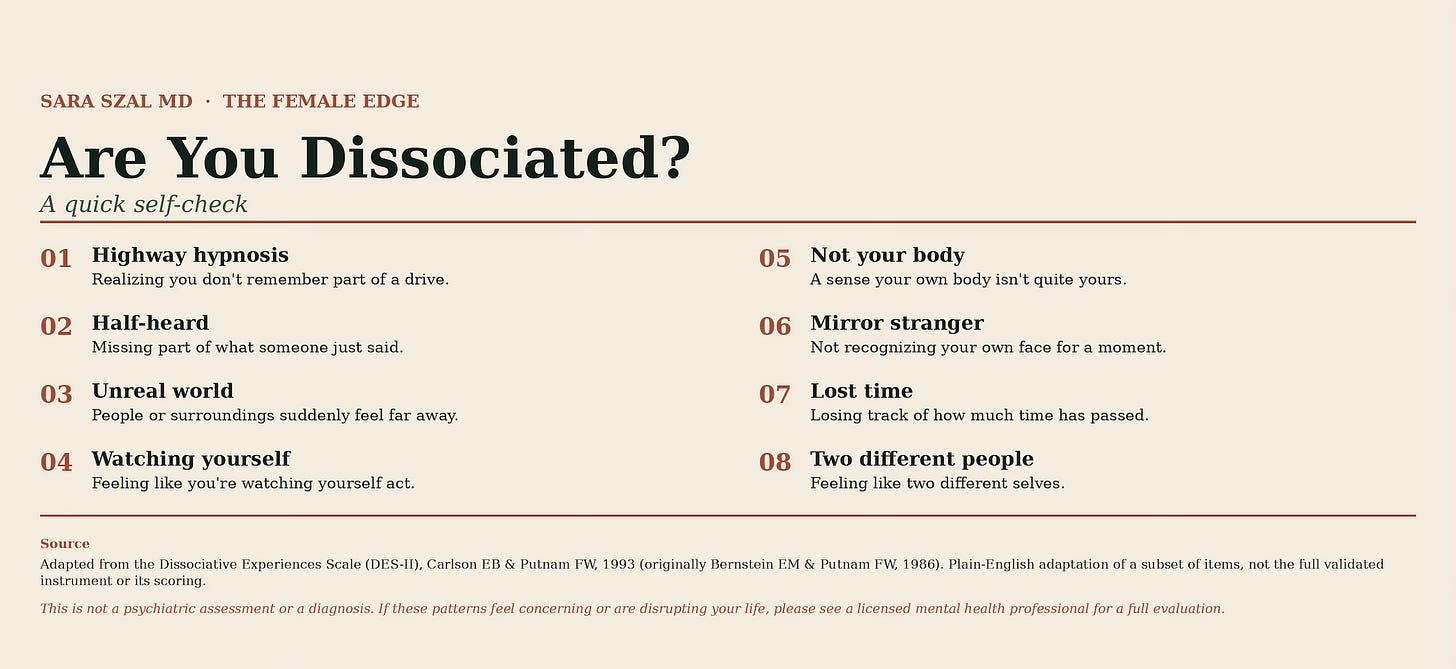
A reader once described self-induced numbing, once it takes hold, as something that starts to resemble dissociation. When I read that, I recognized it immediately as true as a felt sense. I had lived it long before I knew the words to describe it.
Functional dissociation is not the same as the clinical dissociative disorders described in trauma literature. It is something more ordinary and insidious: the adaptive offline state the nervous system learns when emotional presence becomes dangerous.
You are there. You are functioning. You are not completely there.
Research confirms that maltreated youth exhibit dissociation between psychological and physiological stress responses: they report higher perceived anxiety despite blunted cortisol reactivity. [5] The mind and body have stopped speaking the same language. This dissociation mediates the relationship between childhood maltreatment and personality patterns in adulthood, with the strongest associations found for vulnerable narcissism, a pattern of hypervigilance, shame, and hidden grandiosity that can develop in the child of a narcissistic parent. [9]
What functional dissociation looks like in practice:
• You are in the conversation but watching it from a slight remove
• You stop expecting to be met, and eventually stop noticing that you are not
• Competence becomes the substitute for connection
• You are praised for your self-sufficiency, which is your isolation
• You begin doing it everywhere: at work, in friendships, in your own body
• The most insidious cost: you lose access to your own desire, your own knowing, your own no
For highly sensitive person (HSP), the dissociation may go deeper.
The same nervous system architecture that makes us perceptive and attuned may make the suppression more complete. When an HSP goes offline, she goes completely offline. And because her baseline sensitivity is high, the numbness registers as relief, at least initially.
I first noticed I was doing it outside my relationship with my mother when I was in my thirties. I was in a conversation with someone I loved, and I realized I had been watching myself speak for several minutes. My body was present and I was performing my attention. My consciousness was gone, like I was observing myself from the ceiling.
I did not yet have words for what transpired. I just knew that something in me had learned to leave before anyone could make me leave.
Medical training reinforced this ability, in the life-or-death motor vehicle accidents in the emergency room, gunshot wounds, ruptured ectopic pregnancies, crash cesarean sections, the crisis after crisis, year after year. A little dissociation can be helpful.
In medical terminology, somatoform dissociation refers to dissociative experiences that manifest through the body, i.e., disruptions in sensory perception, movement, and physical sensation, rather than through psychological processes like memory, identity, or consciousness. The concept was systematically distinguished it from psychoform dissociation (the more commonly recognized form involving amnesia, depersonalization, derealization, and identity fragmentation). Somatoform dissociation is more common after trauma.
I now know had a mild case of somatoform dissociation.
V. What Brought Me Back
Psychotherapy
The first thing therapy gave me was the experience of being witnessed without the usual performance required. That sounds simple. It was not simple. I had to learn that the relationship would survive my actual feelings. That rupture could be followed by repair. I had not seen that modeled. My nervous system had to be shown it was possible before it could believe it.
Internal Family Systems (IFS)
IFS gave me a map of what had happened inside, the exiled parts of me. The part that learned to go gray rock was a manager: efficient, protective, exhausted. It had been running the show for decades, the one who kept meetings on schedule, kept the marriage functional, kept the body upright long after it had stopped sending anything but distress signals. Managers are strategic. They plan ahead so nothing catches the system off guard. Mine was very good at its job, which is exactly why it took so long to notice it was there.
Behind it was an exile who had been waiting since the pier on the Chesapeake Bay. She held the original fear, the one the manager had been built to contain. Exiles carry the feelings too big for a child to metabolize alone, so the system locks them away and assigns a guard. I also found a firefighter, the part that would reach for overwork or numbing the moment the exile’s feelings threatened to break through. Firefighters do not care about long-term cost. They only care about extinguishing the fire now.
What IFS taught me is that none of these parts are the enemy. Each one formed to protect me at a moment when I had no other resources. The work was not to eliminate the manager, silence the firefighter, or force the exile to hurry up and heal, it was to unblend from them, enough that I could meet each one from Self: the calm, curious, compassionate center IFS assumes every person has, even when it is buried under decades of protective strategy.
Meeting the exile on that pier from Self, rather than from the manager’s efficiency or the firefighter’s urgency, was the first time she was witnessed instead of managed. Once she was no longer carrying her fear alone, the manager finally had permission to rest.
Gray rock as conscious choice
I wrote recently about learning the gray rock method with a person in my current social circle with high narcissistic traits. The gray rock method is a behavioral strategy: you respond to provocations with flat, brief, emotionally neutral answers. You become inert, unremarkable, and not worth the effort.
The distinction that matters is between gray rock as an adaptive tool I choose and gray rock as an automatic pattern running without my awareness. I have lived the second version and it has a physiological cost: suppressing emotional responses chronically activates the same HPA axis stress pathways as the original threat. [4] It buys time and safety while you build the conditions for distance. It is a short-term process, not a destination.
Choosing it on purpose, instead of running it as an automatic program, is an act of sovereignty over my own biology. It is the difference between my nervous system managing me and me managing it.

Bottom line: the modalities above got me partway home.
What closed the gap were additional modalities that I have not written about together before: what returned me to my own body when talk therapy stalled, the situation I could not resolve until I left it, and what functional dissociation was doing to my desire.
In aggregate, all of these modalities helped me reinhabit my body fully and completely. I am grateful for the experience because it has helped me develop capacities I wouldn’t otherwise have. And it has helped me understand what women are experiencing when they check out, and how they might find their way home.
What comes next for paid subscribers is the part of this story that took me the longest to share, starting with the treatment that reached what a decade of talk therapy could not.
It includes the year I finally understood that no amount of nervous system work closes a gap that stays open because the relationship itself is the threat, and what happened in my body once I left.
It includes what I have learned, in my own body and in the bodies of the women I treat, about what functional dissociation does specifically to arousal, to orgasm, and to the felt sense of wanting someone, and why the research on this is more nuanced than either extreme you have probably heard.
Read more