




Published August 5, 2026 11:01AM
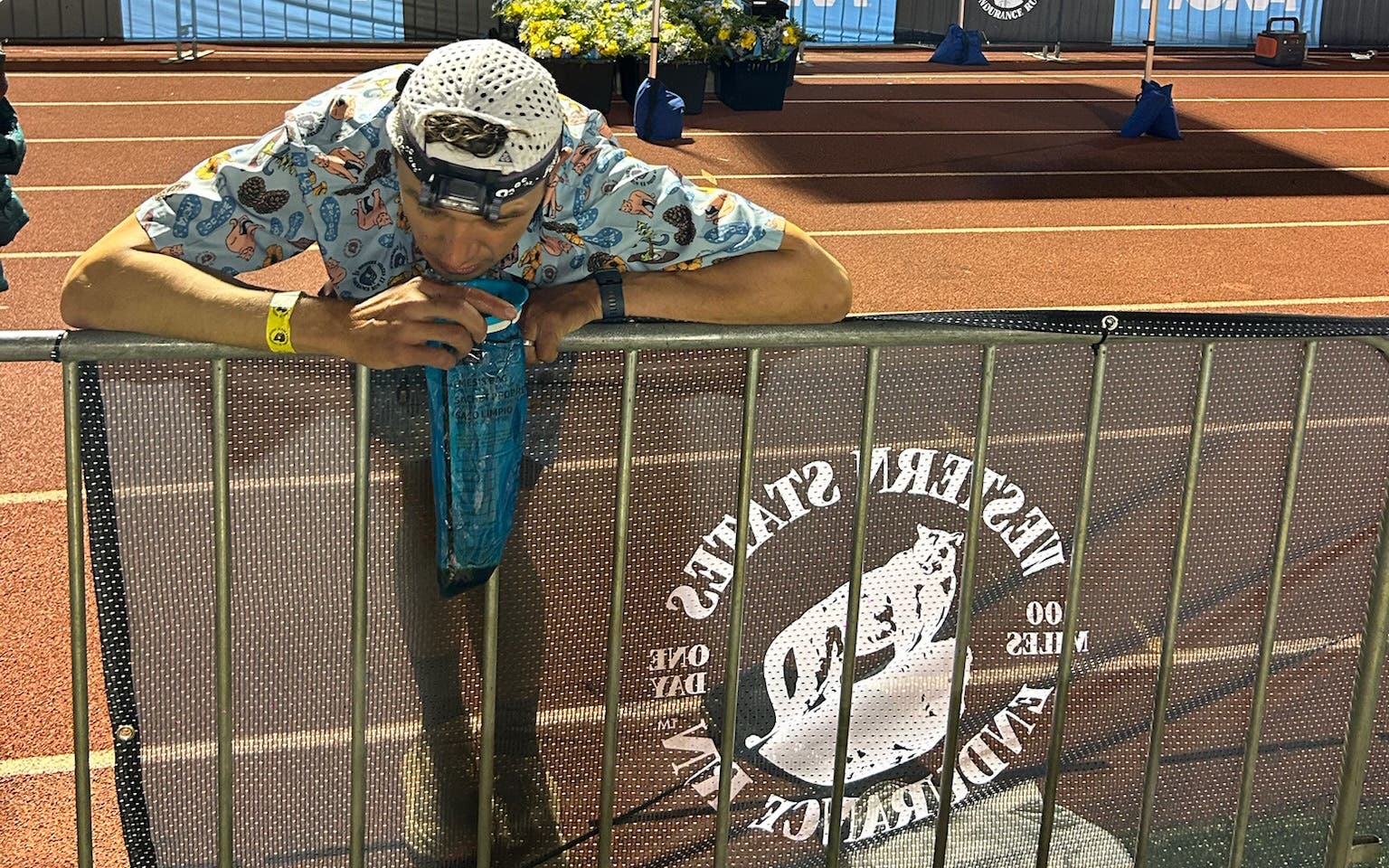
Under a full moon, after more than 20 straight hours of running, Roman Trach lifts his arms and sways back and forth, like a boxer who’s just gone 15 rounds in a heavyweight fight. “I can’t believe this, dude,” he says, shaking his head. “I want to cry so bad.”
Trach’s body doesn’t let him squeeze out the tears. He’s just run 100.2 miles to complete the Western States Endurance Run, the oldest, most prestigious ultramarathon in the U.S., and his body is broken, torn, confused. He has dark hollows under his eyes. His legs are trembling.
He doubles over and begins to puke on the red track, right in front of a booth of broadcasters live-streaming the race. One of the announcers looks over her shoulder to investigate.
“I had like 16 Mountain Dews today,” Trach says with a cough, hunched over. “Tryin’ to get rid of ‘em.”
“Want a 17th?” a friend asks with a laugh. A race doctor runs over to interrupt.
“Just thought I’d check on you,” the doctor says, before handing Trach a blue plastic bag.
Trach thanks her and limps off the track.
When I had approached Trach to ask him about his adventure on the Western States route, his eyes had grown big and spoke for him, as if to say: Get a load of this. He wiped his mouth with the back of his hand and recounted the bizarre journey he took just to arrive at the starting line. A week before the race, which was held on Saturday, June 27, Trach was not yet an official participant. His name was the ninth one on the waiting list to get a Western States entry. By Friday morning, less than 24 hours before the event, he had moved up to first on the waiting list after eight other runners withdrew. Despite his lack of a spot, Trach drove from his home in Folsom, California, to Olympic Valley, in hopes that another runner would no-show, granting him a spot. When a runner dropped out an hour before the deadline, Trach was added to the list.
Trach had started screaming when he learned the good news.
“You know what it was?” he tells me. “It felt like I was on the organ transplant list for six months. And I needed a new kidney by Friday, 1 P.M., and I got it an hour and a half before.”
Trach begins dry-heaving again. He then starts to shake and convulse, and he has to take a break from our interview. He wraps a plaid wool blanket around his shoulders and plops into a lawn chair while more runners come in, sidestepping his vomit on the track.
I watched Trach and hundreds of other runners cross the finish line in Auburn, California. I had set out to follow the race for an entire 24-hour span, talking to everyone I could, from participants to friends and crew members, to officials with the event. I sought to understand how trail running went from a niche activity to a sport exploding in popularity. I’ve never been much of a runner; the most distance I had ever logged in one day was seven miles. Prior to attending the race I couldn’t fathom how people physically run 100 miles, and why they do it.
There is perhaps no race that embodies the rise of ultra trail running more than Western States. “It’s our freaking Super Bowl, man,” Luke Longo, a New Jersey runner, told me. It’s also one of the hardest races to enter. Many runners I spoke to had waited years to get a chance to compete, pinning their hopes on the event’s lottery system. Some athletes I spoke to had never gotten a chance to run. Others who had gotten lucky enough to obtain an entry knew they might not have another chance.
Jeff Browning, 54, had first run the race in 2002 and waited another 14 years to get back in. He came to Olympic Valley to run it a seventh time, finishing the 2026 race in 18 hours and three minutes, the fastest time ever for a runner in the 50-plus age division. Browning, a longtime endurance running coach, did this just 53 days after running in the Cocodona 250 in Arizona, which he promised is as arduous as it sounds. Browning completed Cocodona in just under 71 hours. He’d done 100-milers within a month of each other before, but nothing this crazy.
He laughs at me when I ask how he feels. “I’m…” he pauses and gives a delirious giggle. “My legs are just crushed,” he tells me.
Browning then collapses into a camping chair near the track. I sit cross-legged at his feet, as if it’s story time. He has energy gel stuck in his beard, and he unbraids the crust with a wipe before grabbing a container of chicken meat from his bag. He inhales the bird as he retraces his steps over the previous 18 hours. “I definitely had to go somewhere mentally,” he says.
The afternoon before the race, I’m lucky to get a spot in the Olympic Village Event Center, a historic building with soaring timber ceilings, where there’s a standing-room-only crowd gathered for the pre-race meeting. Athletes competing in the 1960 Olympics once congregated here, and today it’s a madhouse. Fans peek in through the windows. Runners cram behind the stage because there’s nowhere else to sit. A woman waves a giant cardboard cutout of a runner’s face. When Catalan superstar Killian Jornet, one of the sport’s greatest of all-time, enters the room, a few phones spring up to film.
“You don’t have to run Western States to be a part of Western States,” Topher Gaylord, the event’s board of directors president, tells the crowd.
Gaylord, 58, who is decked out in board shorts and barefoot in slides, tells the crowd about the race’s history. Western States started as a horse race in the 1950s, and the course traveled through ancestral lands of the Washoe and Nisenan tribes, up the Sierra high country and down the canyons of the American River before ending/finishing at what many in the sport considered paradise: the track of Placer High School in Auburn, California. “There are no guarantees in a 100-mile race,” Gaylord warns everyone.
Wanting to hear how a horse race became one for humans, I call the first person to run the route on foot. The guy who answers is Gordon “Gordy” Ainsleigh, who is 79 now and a legend in the trail running world. In 1974, when the race was still a horse race, Ainsleigh decided to run it on foot, determined to prove to everyone he could do it in 24 hours. He slept on the floor of a horse trailer near the starting line the night before, then woke up and raced along 198 horses. Ainsleigh arrived in Auburn in 23 hours and 42 minutes. His effort helped birth the modern version of trail running as we know it.
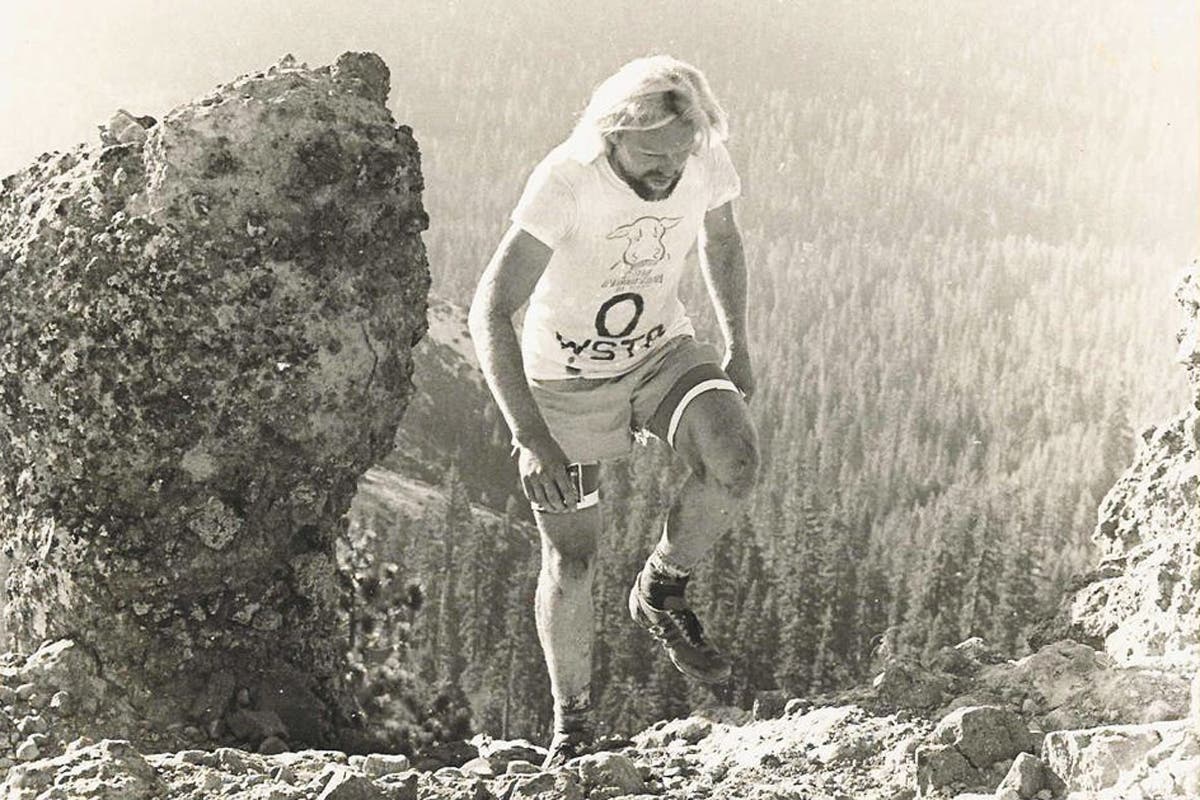
Ainsleigh still comes back every year, helping as a volunteer chiropractor at different checkpoints, although his body doesn’t allow him to run 100 miles anymore. He had milled about in the village earlier, signing autographs and taking photos. Someone had asked Ainsleigh: Don’t you get sick of it?
“Why would I get sick of making people happy?” Ainsleigh told the guy.
He still competes in distance events, although he’s happiest when he’s not running any part of the trails of Western States. When I ask him how it feels to be back, Ainsleigh doesn’t hesitate. “I mostly get depressed, because I can’t do it anymore,” he says. “I wish I could still do it.”
Ainsleigh tells me he’ll be at the Olympic Village later for a book event. When it’s over, he picks me up in his royal blue Honda Fit, not far from where the runners will start the race the next morning. He still wears his hair long and his beard down to his chest, although the blonde has turned white; Ainsleigh is still wiry, trim and tall, his knees barely fitting around the steering wheel of his small car, which feels like a trail runner has been living in for years. The floor is dusted in dirt and pine needles, and there’s a huge bottle of electrolyte fluid in the cup holder.
Ainsleigh parks by a trail, in the shadow of Tahoe mansions that didn’t exist when he first ran here as a young man. He watches runners and hikers pass by with his piercing blue eyes, rubbing his beard while deep in thought. He finally tells me how he first got the idea to run the trail in the spring of 1972, how he had stashed water along the route in advance in order to make it, and how his life had since changed as the race became entwined with the explosion of the sport.
“I figured if I could do it, it would be pretty earth-shaking,” Ainsleigh says. “But it didn’t occur to me that anyone else would ever want to do it.”
As we drive back toward the lodge, he stares out the window at the masses of people who have shown up for race festivities, and before he drops me off back at the lodge, I ask him about all the money that is now pumped into the event by different brands. In fact, I’m attending the event on a press trip for the running brand Hoka.
“Yeah,” Ainsleigh says with a grin. It’s crazy to think now, from where he started, that there are even shoes designed to run trails. “People are always thanking me for starting the race, and I say, ‘Well, I’m grateful to you, because if you didn’t think it was a good idea, I wouldn’t be able to get a pair of shoes.’”
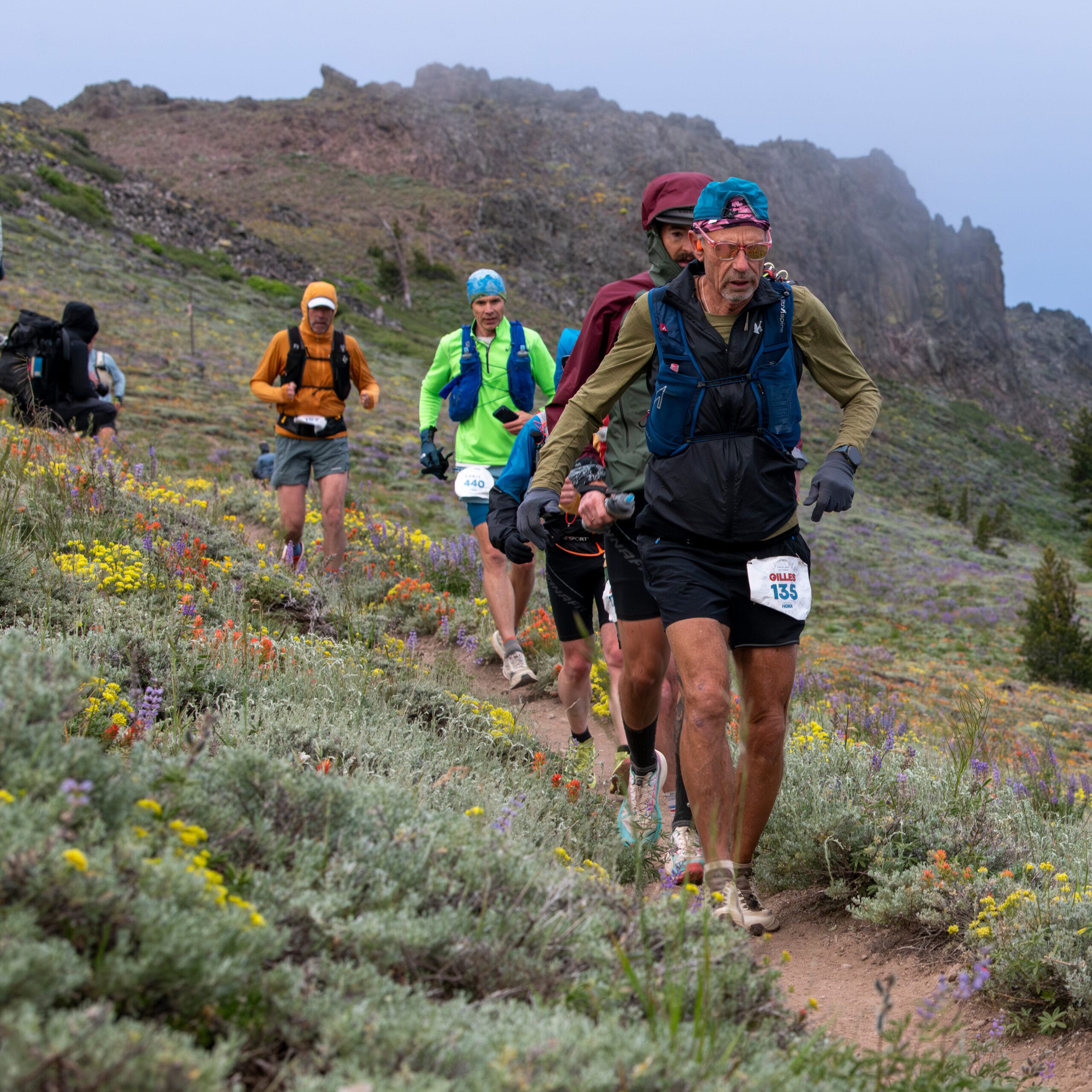
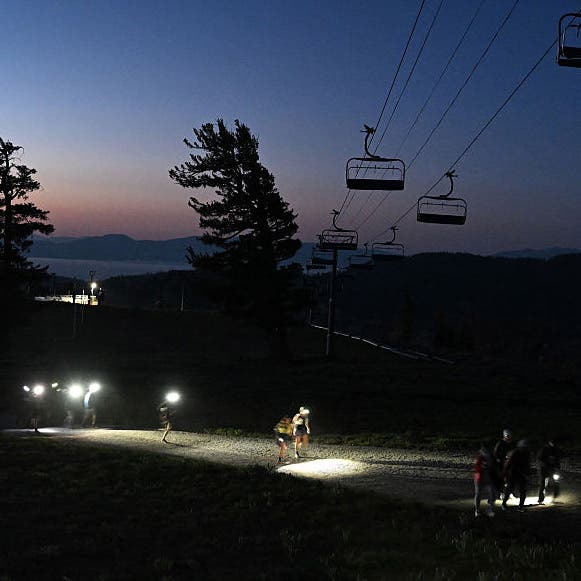
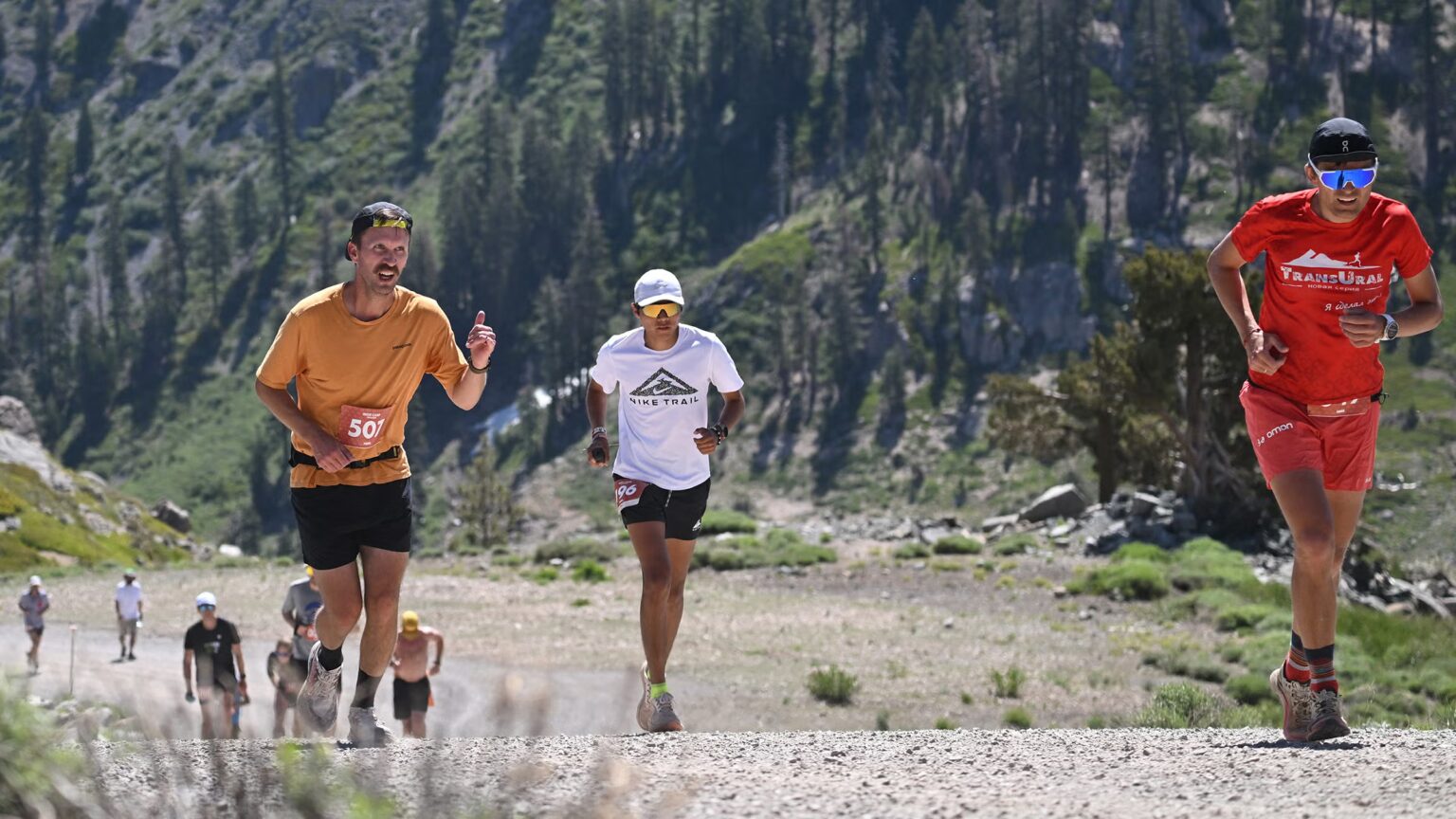
The next morning, as I stumble to the starting line just before the start at 5 A.M., the wind barrels down the mountain. Race officials had warned runners that gusts could reach 60 miles per hour and that the windchill could drop to 33 degrees, making it one of the coldest editions on record.
Some runners absorb the last traces of warmth inside a lodge. A few live-stream their thoughts on social feeds, including Antoine Aubour, a runner from France, who scrolls through his phone one final time before heading out into the cold. “I’m a bit stressed,” he tells me, looking in the direction of a young runner nearby.
It’s Luke Longo, the runner from New Jersey, who likens this to the Super Bowl but has no idea what he’s about to get himself into. His crew consists of his girlfriend, Kelly, who has wrapped herself in a blanket to stay warm, and his work buddy, Bradley. “We’re not as nervous as him,” Bradley says, nodding toward Luke, who cracks a smile.
“I didn’t do enough research for us,” he admits with a nervous laugh, but he’s not kidding. He didn’t fully map out their plans until the day before the race, so he’ll be without drop bags or support for the first 30 miles. I ask him how he feels about it.
“A little tense,” he says. “But once you get going, it’s just running.”
He heads out into the cold with Kelly and Bradley, and together they watch the red numbers of a clock tick down underneath the starting line banner. A race official stands on top of a ladder with a microphone and begins to deliver a sermon to the runners. “Look to your left. Look to your right. You’re all on the same journey,” he says, and hundreds of fans begin to record the final seconds of the countdown.
In the corral, 36-year-old Croom Beatty starts to get emotional. He has been in the lottery since 2018, and it had felt surreal as he drove to race that morning. Now he is standing next to two of the sport’s biggest stars—Jornet and four-time winner Jim Walmsley—as the clock ticks down. “That’s what’s so cool about the sport, is you get to run the same course as your heroes,” he tells me later.
The gun finally pops off, the blast ricocheting into the night, and the runners begin to herd up the mountain before vanishing into the darkness.
I make my way to Foresthill, a small town on a ridge between forks in the American River that was once a crucial trade outpost for gold miners. Its hardware store, firehouse, and saloon are flanked by aid stations for runners at mile 62 of the race. Barbecue smoke curls in the air. A live band plays covers. Fans sip craft brews. Most major brands have tents set up for their athletes—Hoka, Nike, Adidas—nestled on neighborhood sidewalks alongside locals who are hoping to make a quick buck with lemonade stands and garage sales outside their homes.
Near the edge of town, where neighborhoods blend into the forest, the leaders of the race come through, running at a record pace. The aid stations operate almost like NASCAR pit stops; the runners come in, the veins popping in their calves as they slam Coke, and their teams douse them with water and ice and impart whatever coaching they can.
Eventually Walmsley, who is considered one of the best runners of his generation, stops. He’s won Western States four times and holds the course record, but now at the checkpoint, he appears to be in discomfort, whispering something to his team while a gaggle of reporters and photographers dote on his every movement.
He walks into the forest and slips behind a wood shed for a few minutes. While I wait for him to reappear, I remember a scene from a few days before, when at his pre-race press conference, some had wondered if he could set another course record. I had asked Walmsley: How have you watched the sport grow since you first raced here a decade ago? (and famously took a wrong turn on the trail and got lost).
“When I look at it, it’s an overall sports growth of professionalization and finding more of those marginal gains,” he told me. “I think we’re seeing this across sports, and it’s definitely bleeding over into a deeper, faster trail running, ultrarunning.”
Walmsley is about 15 minutes behind the leaders, in seventh place, but must bow out for medical reasons. He returns from the woodshed and cuts off his participant’s wrist band, tossing it in a trash bin. There were no guarantees here, just as Gaylord, the president, had said.
“Thank you, everyone,” Walmsley says to the crowd watching. “Wasn’t my day.”
It will be someone’s day, so I hustle to a shuttle to get ahead of the leaders, boarding a white van that hauls down a mountainside as if the driver is nervous she might not get us there in time. A squeamish fan grabs my arm as the van rumbles. “Don’t look down,” she tells me. Our driver weaves around runners on the road and straddles the edge of a cliff right above the American River, and just below, I can see the Rucky Chucky checkpoint, mile 78, one of the most scenic, and pivotal, points of the race.
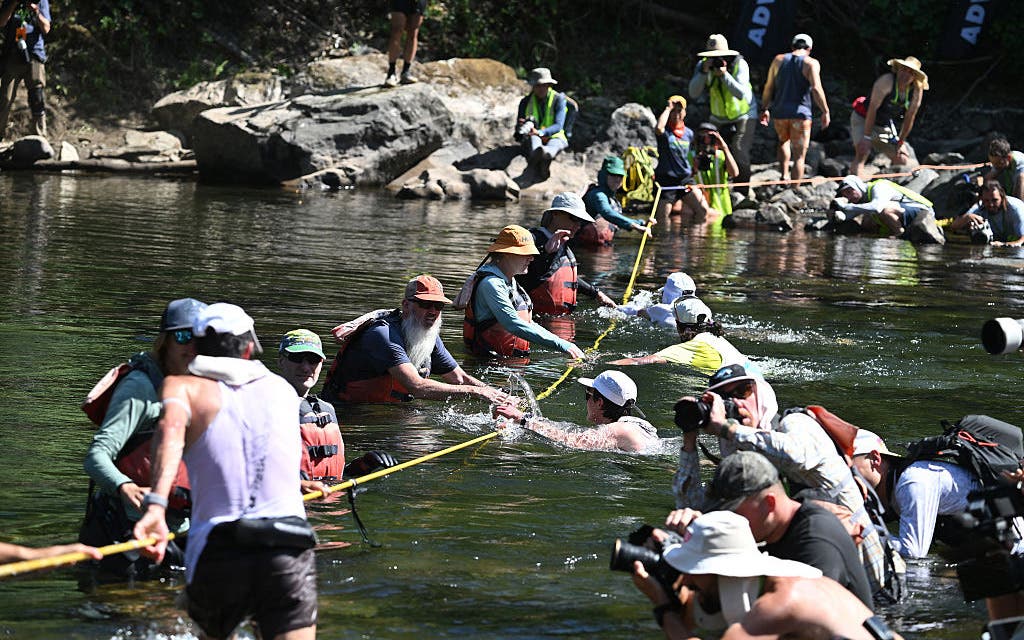
A volunteer waves spectators through with a smile and a sign that reads: “Rattle Snakes. No we are not kidding.” It’s not the only hazard at this checkpoint. The runners must cross the river at a junction just above Class VI whitewater rapids, pulling themselves through the water by rope, while rescue teams in rafts float and keep a watchful eye.
Some spectators take off their shoes and wade into the water to watch, but the aid station is powered by an army of volunteers, some of whom have been stationed here for decades. More than 10,000 volunteer hours are donated to ensure that the trail is ready to run. When the sun goes down at Rucky Chucky, Phil Neer oversees the camp’s electrical output so the runners will have light to cross the river in the middle of the night. He’s been doing it for 17 years, watching the hype build more and more with each one. “With the companies sponsoring it, it’s gotten more intense,” Neer says. “I’ve done 50Ks. That’s my limit.”
He points me to Carolyn Latham, one of the chief volunteers at the station who ran the race last year. “This trail is ingrained in my blood,” she tells me. Generations of her family raced horses on the trail, starting with her great-grandmother in the late fifties. For the longest time, completing Western States was a bucket list item. She strictly ran marathons. “And I almost died running marathons,” she says. “It took me a long time to get to the point where I even thought I could do it.”
“And you know, what’s really amazing about it? I had somebody ask me, like, why? Why do we ride and why do we run it? And I say, we ride to stay connected to history,” she says. “…and then we run to see what the human body can do.”
On the banks of the river, 80-year-old Will Uher finds a spot to watch, his beat-up Hokas just edging the water. He wears an official race T-shirt from 1998, when he ran it for the third and final time, but he hasn’t been back here since. “There’s so many more people now,” he says, marveling at the crowds before he holds up his phone to film a runner who splashes into the river. “I just wanted to come down and feel the energy.”
Along with Uher, I head back to the shuttle to hitch a ride back up the canyon and to the finish line at Placer High School’s stadium in Auburn. I arrive just minutes before the first runners come in at 6:45 p.m. Thousands of fans have already filled the bleachers and unfolded camping chairs on the football turf.
Near midfield, I sit next to a group of friends who pull wine bottles out of picnic baskets and catch up while their kids throw a frisbee. Food trucks park off the curb of the red track. A rusted orange freight train blows through town behind the tiny press box. The announcer says that the leader, Vincent Bouillard, is coming in and about to set a course record; a wave of fans jump to their feet, sprint across the field, and try to elbow their way to get a spot near the finish line.
One fan looks at his watch. “Holy shit! He’s going to beat it by 30 minutes!” the guy says out loud, and when Bouillard finally finishes to a cacophony of cowbells and vuvuzelas, he’s surpassed Walmsley’s record by more than 23 minutes. Soon after, Jenn Lichter, who had never run a 100–miler, finishes with the fastest ever time in the women’s race as fans wave signs, including one that reads: “Jenn when I grow up I want to be like you!”
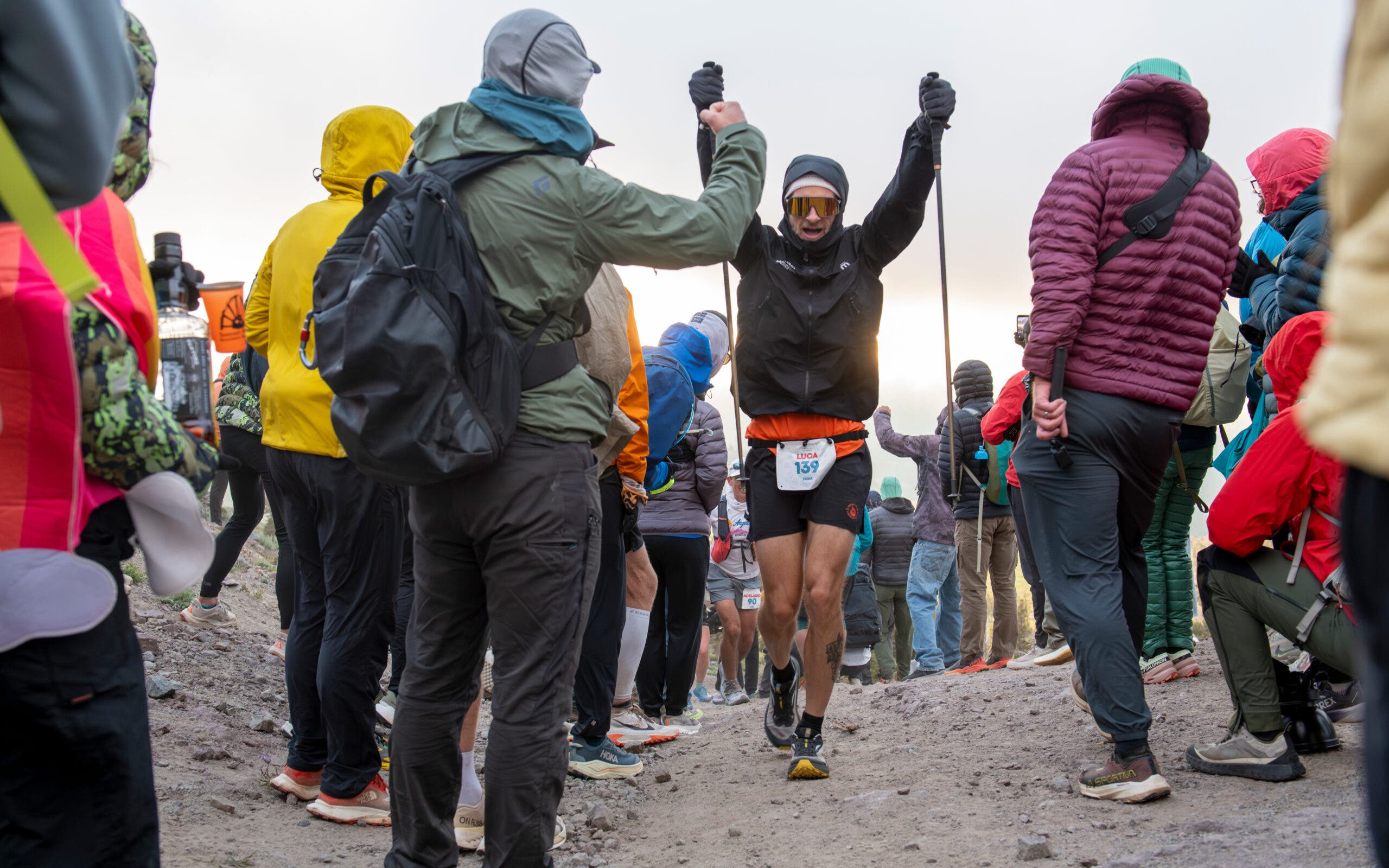
One by one, runners finish as the sun sets and the shadows grow long on the track. Most of those who cross the line in the dark do not have a shoe sponsor. The crowd thins out as midnight approaches, and the temperature drops below 50 degrees.
Fewer and fewer fans remain at Placer, aside from the loved ones waiting to see their runners come through. Some spectators nestle themselves into sleeping bags on the turf. A few crack open cans of paint and brush out signs. Some runners sit with their families in the bleachers afterward, and even as their bodies tremble, they share what they went through on the trail.
I see a runner cross the line. He’s Isaac Frank, from Colorado, who had struggled through the canyons and relied on his team to guide him through the pain over the last 20 miles. “If you want to see what you’re made of, against some of the best in the world…you come here,” he says.
There is Fiona Pascall, from Great Britain, who nearly pulled out of the race a month before due to injury and had run most of the course by herself, but had stuck it out even as she lacked motivation. “It was really stressful, the last 35K, but I’m really happy,” she says.
There is Ellaney Matarese, from California, who needs help putting long pants on after she finishes, but still wears a smile on cheeks that have been painted with glitter.
Matarese had slept through her first three alarms and arrived at the starting line just moments before the gun, panicked and stressed. At 23, she was the youngest runner in the field, and while she quickly realized she couldn’t ease into the race because of the pace, she found a way to finish 16th on the fastest day in the event’s history.
“It feels awesome. I mean, I’m very tired,” she says, echoing what more than a dozen other runners had told me throughout the night: people run ultras to push themselves to the limit, but also to share the experience and euphoria with others.
“If you ask most people what they love most about ultra running, it is community,” says Joe Corcione, who stops to talk with me just after finishing before 2 A.M.
Corcione eventually embraces Roman Trach, who, like so many other runners on this night, feels the physical withdrawals after stopping. I listen as Corcione stops to tell the broadcasters on the livestream the backstory to his life as an ultrarunner: a decade ago he was addicted to drugs, and he had started running to help get sober. He first read about Western States in a book and, captivated by it, came here as a crew member for another runner before he ran it himself. He eventually leaves the set and stops to talk with me for a few more minutes. “If you’re ever skeptical of what it’s about, just be here, spectate it, and you will see, and you will be hooked and want to run this race,” he says.
Before I watch the sunrise at 5 A.M., with some runners beating the 24-hour clock by mere minutes, I speak with Emily Hawgood, one of the sport’s most successful runners. I tell her that it was my first time at Western States. I tell her that I’m curious how people find their way to this sport, let alone this race.
She had grown up on a farm in Zimbabwe and had fallen in love with trail running after competing in track in Idaho in College. She had finished in the top ten five times at Western States before, but this year, she came in 17th. Hawgood looks tired, with flushed cheeks. “I was in tears out there, not ’cause I was having a tough day,” she says. “But because of the magic of getting to run on this trail.”
A friend of Hawgood’s eavesdrops on our conversation. After Hawgood departs, she pats me on the shoulder and leans in to say something.
“Hey, welcome to the community,” she says. “Drink the Kool-Aid. It’s worth it.”